3.1.11 Tayyamum

[one_half][box type=”success”]

In this unit:


  • If we cannot make wudu, we must make tayyamum in place of wudu.
  • Tayyamum can be made if you have no water or the water will harm you.
  • Tayyamum has 4 arkan.

[/box][/one_half]

[one_half_last][box type=”note”]

Keywords

  • Tayyamum
  • Dust[/box][/one_half_last]

[dropcap]W[/dropcap]e explained that wudu and ghusl can only be made with purifying water. But sometimes, we cannot make wudu or ghusl, either because we do not have water, or because using the water would somehow hurt us. Allah has given us permission to make tayyamum in place of wudu or ghusl when we cannot use water for wudu.

Tayyamum does not purify you like wudu and ghusl, but it does allow you to do the things that you need wudu and ghusl for. For example, you can make tayammum and then pray or touch the Qur’an.

Tayyamum does not clean najasah. It only replaces wudu and ghusl.

To make tayyamum, you use pure and purifying dust. This dust can be found mixed with soil or sand. To be sure that the material you are using is really dust, strike it with your hand and make sure the dust rises up in a cloud. If a dust cloud does not form when you strike the material you have, then it is not dust and can’t be used for tayyamum.

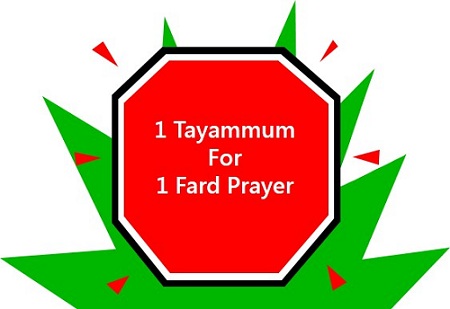
There is something important to know about tayyamum. Only one fard act can be done with one tayyamum. That means one needs a new tayammum for every fard prayer and every
fard tawaf. But on can pray many sunnah prayers with the fard prayer. It’s like wudu gives you an unlimited pass on fard prayers until you break your wudu, but tayammum is a once-only pass for fard prayers.
Tayyamum2

When Can You Make Tayyamum?

[toggle title=”1. If you are travelling or living outside the city and you cannot find water.” state=”close”][one_half][/one_half]
[one_half_last]Jeep in desert[/one_half_last][/toggle]
[toggle title=”2. If you have a wound on an organ that must be washed in wudu (or ghusl)” state=”close”][one_half]but washing that wound will be harmful to you.[/one_half]
[one_half_last]Bandage[/one_half_last][/toggle]

The Steps of Tayyamum

[toggle title=”1. Strike the dust with both hands while saying your niyyah.” state=”close”] [one_half]You must say in your niyyah why you are making tayyamum.[/one_half]

[one_half_last]Tayyamum5[/one_half_last][/toggle]

[toggle title=”2. Wipe your face with your hands.” state=”close”] [one_half]Wipe from your hairline to below your chin and from one ear to the next. Do not miss any part of your face, especially the skin between your mouth and nose![/one_half]

[one_half_last]Tayyamum6[/one_half_last][/toggle]

[toggle title=”3. Strike the dust again.” state=”close”][/toggle]

[toggle title=”4. Wipe your arms” state=”close”] [one_half]first the right arm then the left arm. Wipe the entire arm from the tips of your fingers to your elbow. Make sure you do between your fingers and also your elbow.[/one_half]

[one_half_last][/one_half_last][/toggle]

[toggle title=”5. Do it all in the order” state=”close”]1, then 2, then 3, then 4.[/toggle]

The Fard Acts of Tayyamum (The arkan of tayyamum)

1. Niyyah
2. Striking the dust 2x
3. Wiping the face and arms
4. Doing the steps in order.

How to Make Tayyamum if You Are Wearing a Cast or a Bandage

[two_third]If you have a cast or a bandage on a part of your body that you must wash during wudu, such as your foot, then you will not be able to wash your foot during wudu. Instead of washing your foot, you must make a tayammum that takes the place of washing your foot. Because order is fard in wudu, you will make tayammum when you come to the washing of the foot.[/two_third]
[one_third_last]Cast or bandage[/one_third_last]

Here is what you do:

1. Start making wudu by saying the niyyah while washing the face. Then wash your arms and wipe your head.
2. Wash whichever part of your feet that is uncovered.
3. Wipe water over the cast on your foot.
4. Make tayammum as described above.

[box type=”warning”]You cannot make tayyamum in a city because there will always be water available somewhere. If you can’t find any, make tayyamum and pray; but then pray that prayer again when you find water.[/box]
[divider]
[button color=”blue” size=”medium” link=”http://www.deenteens.com/worksheets/3.1.11 tayammum.pdf” target=”blank”]Worksheet[/button]

3.1.12 Wiping on Khuffs

[one_half][box type=”success”]

In this unit:


  • A khuff is a special footwear that you can wipe on instead of washing your feet in wudu.
  • A khuff must fulfill certain conditions.

[/box][/one_half]

[one_half_last][box type=”note”]

Keywords

  • Khuff/Khuffayn
  • Waterproof
  • Traveler
  • Resident[/box][/one_half_last]

[dropcap]A[/dropcap] khuff is a leather sock or boot that people wear on their feet. A pair of them is called khuffayn. We’ll just call them khuffs to make it easier to remember. Here are some examples of khuffs. The ones that look like socks are special sports socks that fulfill the conditions for khuffs, which we’ll discuss below.

3.1.12 types of khuffs

If you are wearing khuffs, you can wipe on them in wudu instead of washing your feet, but with some rules.

To start with, you have to put on your khuffs after you are completely pure (meaning you made wudu and ghusl if you needed to). You must not take the khuffs off. In fact, you must pray in the khuffs that you wiped on.

Conditions for the Kuff

Not just any socks or boots will do for wiping. Here are some conditions the khuffs have to fulfill in order to be able to wipe on them.

[toggle title=”1. The khuffs must cover the part of
the foot that is washed in wudu” state=”close”]i.e. the entire foot up to and including the ankles.
[three_fourth]Converse[/three_fourth]
[one_fourth_last][/one_fourth_last][/toggle]

[toggle title=”2. The khuffs must be strong enough for you to be able to walk in it on land that’s of medium roughness.” state=”close”]If it’s only good for your comfy house tiles, like thin dress socks, then it’s not good for wiping. And you sure won’t be able to walk on jagged mountains with thin dress socks. Ouch!

[three_fourth][/three_fourth]
[one_fourth_last][/one_fourth_last][/toggle]

[toggle title=”3. It must be strong enough to prevent water from reaching the foot (waterproof).” state=”close”]If the material is durable, then it will be strong enough to prevent water from reaching the foot. It doesn’t matter what your khuff is made from, as long as it’s strong enough material e.g. sealskinz socks or leather socks.
 
This doesn’t mean you have to be able to take a dip in the ocean with your khuff. The important thing is, if you drip water on it, the water won’t reach your foot.[/toggle]

[toggle title=”4. The khuffs and your feet must be pure at the time you are wiping on it.” state=”close”]If there is najasa on your khuffs or feet, remember to purify them first before putting your khuffs on and wiping over them.[/toggle]

How long can I be wiping?

[one_half]Old clock[/one_half]
[one_half_last]1. For 72 hours if you are a traveller on a long trip in which you are allowed to shorten your prayers.

2. For 24 hours if you are not traveling on a trip in which you can shorten your prayers.
We’ll talk about who can shorten prayers in another lesson.[/one_half_last]

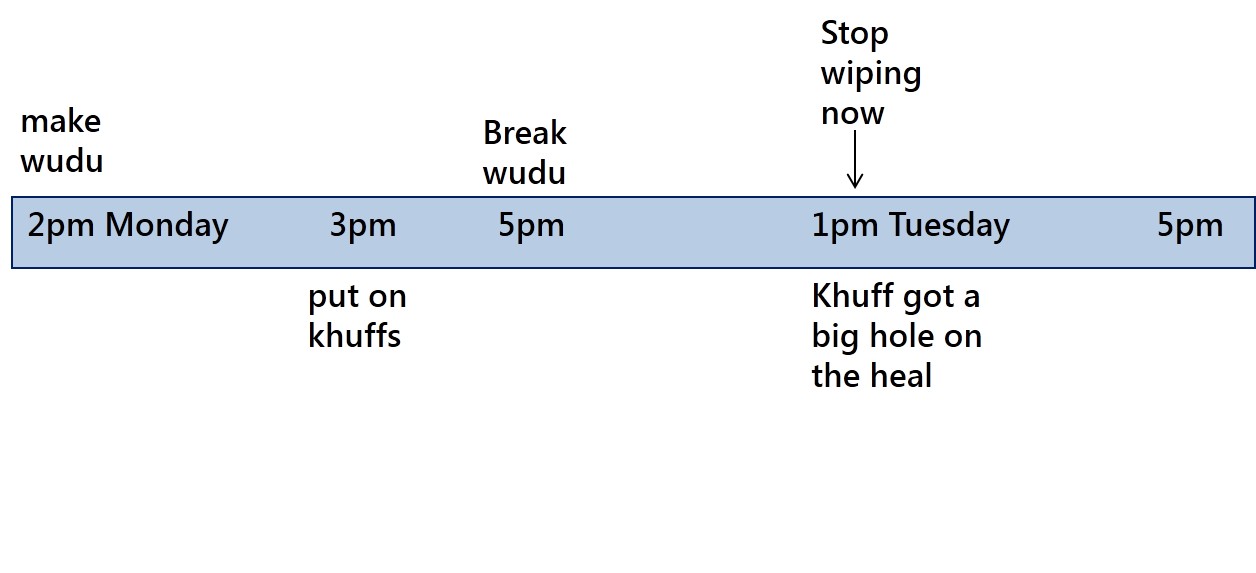
Your time limit starts from the time you lose your wudu, not from the time you put on your khuffs. Think about it this way – the ‘stopwatch’ on your khuff only starts ticking once your wudu is broken. For example, if Iman makes wudu at 10 am, puts her khuff on immediately, then goes to use the bathroom at 12 pm, her khuff is valid for 24 hours from 12 pm.

You can’t wipe anymore if:

1. You take off your khuff or khuffs.
2. The khuff no longer fulfills the conditions for wiping, such as having a hole in it.
3. You end your time limit of 24 or 72 hours.
4. You get major hadath.

Take a look at this:
Wiping on Khuffs4

How to wipe a khuff?

[one_half]Make wudu completely by washing all the organs of wudu.

Put on your khuffs.

Next time you break your wudu and want to make a new wudu, perform the wudu like usual. But then, when you get to your feet, wipe your khuffs instead of washing your feet.[/one_half]

[one_half_last]Wiping on Khuffs5[/one_half_last]

To wipe your khuffs, wet your hand and wipe the top of the khuff. Make sure you wipe the top. If you don’t wipe the top, it doesn’t count, even if you wipe other parts.
[divider]
[button color=”blue” size=”medium” link=”http://www.deenteens.com/worksheets/3.1.12 khuffs.pdf” target=”blank”]Worksheet[/button]

3.2.1 The Salah (Prayer)

[one_half][box type=”success”]

In this unit:

  • The Salah is the most important worship a Muslim performs.
  • Fard acts are the most important acts we do; however, even sunnah acts will make us better Muslims.[/box][/one_half]

[one_half_last][box type=”note”]

Keywords

  • Salah
  • Arkan
  • Rukn[/box][/one_half_last]

[dropcap]T[/dropcap]he first of our acts that will be judged by Allah on the Day of Judgment is our prayer. If the prayer is good, all our other acts will be good. May Allah fill our scales with accepted prayers. Our salah or prayer is the special way we worship Allah.
 
In these lessons, you will not learn the whole process of prayer. You need to learn that from your teacher. It will require a lot of practice; may Allah make it easy from you and accept all your prayers.
 
You will learn the arkan of prayer. Remember that arkan is the plural of rukn (which are the acts that are fard). You will also learn what acts in the prayer are sunnah (highly recommended to do) and what acts are hay’ah (recommended).
The reason we learn about the different types of acts in prayer is so that we know how to fix any mistakes we make in our prayer. You fix a mistake in a fard of prayer in a special way.
 
Some people think that if an act is not fard, it is not important. That is not true at all. All our worships are important. The more you do for Allah, the more He will love you and reward you. And we all need as much love and reward as we can get!
 
[toggle title=”The Definition of Salah” state=”open”]

Salah is specific words and acts that begin with takbir and end with taslim,
with certain conditions.

[/toggle]

[box type=”warning”]Each of the 5 daily prayers acts like a purification for the Muslims. It washes away our sins.[/box]

3.2.5 Conditions of Prayer

[one_half][box type=”success”]

In this unit:

  • There are 5 conditions you must fulfill before and throughout the prayer.
  • If any of these 5 things is not taken care of, your prayer will be invalid.

[/box][/one_half]

[one_half_last][box type=”note”]

Keywords

  • Conditions
  • Prerequisites
  • Awra
  • Qibla[/box][/one_half_last]

[dropcap]T[/dropcap]here are 5 conditions we must fulfill before we start our prayer. That means there are 5 things we have to do for prayer before we even start praying. These conditions are not part of the prayer. They are prerequisites we must take care of before and during the prayer. A prerequisite is something we are required to do even before we start to pray. Without these, our prayer isn’t valid – our prayer is disqualified.

[toggle title=”1. We must purify ourselves from hadath and filth” state=”open”][one_half]We lift hadath by making wudu and/or ghusl. We remove filth by washing it away from our body and clothes. If filth comes on you, you just wash off the place of the filth with purifying water. You do not have to make wudu if you have filth on you. Wudu is only for lifting hadath.[/one_half]

[one_half_last]

Conditions of Prayer3.jpg
As you make wudu, the hadath (“green paint”) comes off you

[/one_half_last]
[/toggle]

[toggle title=”2. We must cover our awra with pure clothes” state=”close”][one_half]The awra is the parts of the body that have to be covered. In prayer, the awra for girls is everything but the hands and face. Make sure everything else is covered. The color and shape of the body should not show through your clothes. For boys, the awra is from the belly button to the knees. It is also good to cover the upper body. Make sure your clothes are pure; there should be nothing najis on them.[/one_half]
[one_half_last]Conditions of Prayer4[/one_half_last]
[/toggle]

[toggle title=”3. We must stand on a pure place” state=”close”][one_half]Make sure there is no najasa in the place you are standing to pray. The best thing to do is put a prayer rug on the floor or ground. Always keep your prayer rug clean.[/one_half]
[one_half_last]Conditions of Prayer5[/one_half_last][/toggle]

[toggle title=”4. Before we start praying, we must be sure that the time of prayer is in” state=”close”][one_half]Do not start prayer until you are sure the time is in, otherwise you have to pray again.[/one_half]
[one_half_last]Conditions of Prayer6[/one_half_last][/toggle]

[toggle title=”5. We must be sure to face the qiblah” state=”close”][one_half]The qibla or direction for prayer is the Ka’ba in Makkah. If you cannot figure out the direction of the qiblah by yourself, ask someone who would know.[/one_half]
[one_half_last]Conditions of Prayer7[/one_half_last][/toggle]

There are only two situations in which we do not have to face the Qibla:

3.2.5 pray sitting
[divider]
[button color=”blue” size=”medium” link=”http://www.deenteens.com/worksheets/3.2.5 conditions for prayer.pdf” target=”blank”]Worksheet[/button]

3.2.7 Arkan al-Salah or the Fards of Prayer

[one_half][box type=”success”]

In this Unit:

  • There are 13 Arkan (fard acts) in prayer.
  • The arkan must never be skipped or the prayer will not be valid.

[/box][/one_half]

[one_half_last][box type=”note”]

Keywords

  • Rukn/Arkan
  • Tuma’ninah
  • Ruku
  • Sajdah[/box][/one_half_last]

The Importance of the Arkan

[dropcap]A[/dropcap]rkan are the fard acts of any worship. Acts that are fard must never be skipped. If you skip a fard act, your prayer won’t be valid. Skipping a fard act will automatically disqualify your prayer. If you leave a fard by mistake or by forgetfulness, you must correct yourself. If you don’t correct yourself, your prayer won’t be valid.
We’ll learn how to correct mistakes or matters of forgetfulness in another lesson.

The 13 Arkan of Prayer

There are 13 fards in prayer (you can also say there are 17 if you count each tuma’ninah separately):

1. Standing
2. Niyyah
3. The opening takbir (Allahu akbar)
4. Reciting the Fatihah (bismillahir rahmanir rahim is its first ayah (verse))
5. Ruku’ and tuma’ninah in it (relaxing/resting)
6. Standing straight (after ruku) and tuma’ninah
7. Two sajdahs and tuma’ninah
8. Sitting between two sajdahs and tuma’ninah
9. The final tashahud
10. The final sitting
11. The final salah on the Prophet
12. The first assalamu alaikum (which ends the prayer)
13. Doing it all in order.

In this next section, you must put on your thinking cap because we will give details on each of the 13 arkan. Each day, as you pray, try to pay attention to doing each rukn of prayer correctly. Practice makes perfect!

The 13 Arkan Explained

[toggle title=”1. Standing” state=”open”][one_half]The prayer has to be performed while standing facing the qiblah with your chest. That means your chest should always be toward the qiblah. If a person is very sick, then he can pray sitting or lying down. May Allah keep us and our loved ones in excellent health![/one_half]
[one_half_last]Arkan al-Salah or the Fards of Prayer2[/one_half_last][/toggle]

[toggle title=”2 and 3. Say the niyyah in your heart while saying Allahu akbar with your tongue.” state=”close”][one_half]The niyyah should be said like this: I intend to pray fard/sunnah (say if it is fard or sunnah) (name which prayer you are praying: fajr, zuhur, asr, maghrib or isha) prayer. In Arabic you would say:

نَوَيتُ أن أُصَلِّي صَلاةَ الظُهرِ فَرضاَ عَلَيَّ[/one_half]

[one_half_last]Arkan al-Salah or the Fards of Prayer3[/one_half_last][/toggle]

[toggle title=”4. Reciting the Fatihah” state=”close”][one_half]Please recite the words of the Fatihah with your teacher so he or she can make sure that you do not make any mistakes. Remember that the first verse of al-Fatihah is:

بِسْمِ اللّهِ الرَّحْمـَنِ الرَّحِيمِ[/one_half]

[one_half_last]Arkan al-Salah or the Fards of Prayer4[/one_half_last][/toggle]

[toggle title=”5. Ruku and tuma’ninah” state=”close”][one_half]The minimum ruku’ is to bend down until your hands are at the level of your knees. But you can do better than that by bending your back until it is flat, as in the picture. You must have tuma’ninah whenever you go to a new position in prayer. Tuma’ninah means to be relaxed in that position.[/one_half]

[one_half_last]Arkan al-Salah or the Fards of Prayer5[/one_half_last][/toggle]

[toggle title=”6. Standing straight (I’tidal) and tuma’ninah” state=”close”][one_half]After ruku’, you must return to a completely straight standing position. Remember to relax in your standing position because you must have tuma’ninah in every new position in prayer.[/one_half]

[one_half_last]Arkan al-Salah or the Fards of Prayer6[/one_half_last][/toggle]

[toggle title=”7. Two sajdahs and tuma’ninah” state=”close”][one_half]When you make sajdah, 7 bones must touch the ground.

a. The forehead – your skin must touch the ground directly. Do not let your scarf or your hat get in the way.
b. Your two hands – your palms must be flat on the ground.
c. Your two knees.
d. The bottom part of the toes of your two feet.

Of course, do not forget tuma’ninah.[/one_half]

[one_half_last]Arkan al-Salah or the Fards of Prayer7[/one_half_last][/toggle]

[toggle title=”8. Sitting between the two sajdahs and tu’amnihah” state=”close”][one_half]When you rise from the first sajdah, you must sit straight down before you go down for the second sajdah. In each sajdah, you must have tuma’ninah. There are special ways to sit during the middle tashahud and the last tashahud. You aren’t required to sit like that, but it’s really good to do if you can. Ask your teacher how to do it. The important thing is to be sure you sit straight down and do not forget tuma’ninah.[/one_half]

[one_half_last]Arkan al-Salah or the Fards of Prayer8[/one_half_last][/toggle]

[toggle title=”9. The final tashahud” state=”close”]This comes at the very end of your prayer after the last rak’ah of the prayer. While you are sitting, recite the following correctly:

التَّحِيَّاتُ الْمُبَارَكَاتُ الصَّلَوَاتُ الطَّيِّبَاتُ لِلَّهِ السَّلَامُ عَلَيْكَ أَيُّهَا النَّبِيُّ وَرَحْمَةُ اللَّهِ وَبَرَكَاتُهُ السَّلَامُ عَلَيْنَا وَعَلَى عِبَادِ اللَّهِ الصَّالِحِينَ أَشْهَدُ أَنْ لَا إِلَهَ إِلَّا اللَّهُ وَأَشْهَدُ أَنَّ مُحَمَّدًا َرَسُولُ اللَّهِ[/toggle]

[toggle title=”10. The Final sitting” state=”close”][one_half]This is when you sit while reciting the tashahud at the very end of your prayer. You have to sit even if you can’t recite the tashahud. Can you think of a situation in which you can’t recite the tashahud but you still have to sit?[/one_half]

[one_half_last]Arkan al-Salah or the Fards of Prayer8[/one_half_last][/toggle]

[toggle title=”11. The final salah on the Prophet” state=”close”]After you finish the final tashahud, you must say salah on the Prophet. This is said in the final sitting.

Say:

اللَّـهُمَّ صَلِّ عَلَى مُحَمَّد

[/toggle]

[toggle title=”12. The first taslim (saying assalamu alaikum)” state=”close”]The fard part is to say assalaamu alaikum. When you say these words, it ends your prayer. Only the first taslim is fard. The second one is not. This is said in the final sitting.[/toggle]

[toggle title=”13. Do it all in order” state=”close”]If you make mistakes and things get out of order, you have to correct the mistakes. We’ll see how to correct mistakes in another lesson.[/toggle]
[divider]
[button color=”blue” size=”medium” link=”http://www.deenteens.com/worksheets/3.2.7 Arkan of Prayer.pdf” target=”blank”]Worksheet[/button]

3.2.8 The Important Sunnahs of Prayer

[dropcap]S[/dropcap]ome acts in prayer are important sunnahs. If you leaves these, you need to make sujud al-sahw. Others acts in prayer are lesser sunnahs.
[divider]

[one_half][box type=”success”]

In this Unit:

  • There are 5 Sunnah mua’kkadah acts in prayer.
  • If we forget or miss a sunnah mu’kkadah act, we should perform Sujud Al-Sahw to correct our mistake.

[/box][/one_half]

[one_half_last][box type=”note”]

Keywords

  • Sunnah
  • Ab’aad
  • Hay’ah/Hay’aat
  • Sujud Al-Sahw
  • Du’a Qunoot

[/box][/one_half_last]

[one_half]13 Arkan - 3.2.3[/one_half]

[one_half_last]

Review of the Arkan of Prayer

[dropcap]I[/dropcap]n unit 3.2.7, we learned that there are 13 acts that are fard in our prayer. That means we must never purposely leave out those. If we leave one of those acts out by accident or if we forget one of them, we must make the act up. We will learn how to do that later insha’Allah.[/one_half_last]

Ab’aad of Prayer (The important sunnahs)

There are six more acts in prayer that we should do regularly because they are very important sunnahs. That means they aren’t fard acts, but let’s try our best not to leave them. The technical name for these sunnahs is ab’aad. If we forget any of them, we don’t need to repeat them. In fact, we actually musn’t go back to the missed sunnah act or it will invalidate our prayer. Instead, if we miss one or more of the ab’aad, we should perform sujud al-sahw (sujud for forgetting). Sujud al-sahw will be covered in unit 3.2.9.

Important Sunnahs of Prayer

[toggle title=”1 through 4 are related to the Tashahud” state=”close”][one_half]
1. Sitting for the middle tashahud.

2. Reciting the middle tashahud.

3. Saying “Allahumma salli ‘ala Muhammad” after the middle tashahud.

4. Saying “wa ‘ala aali Muhammad” after the last tashahud.
[/one_half]
[one_half_last]Prayer sitting - 3.2.3[/one_half_last][/toggle]
[toggle title=”5 and 6 are related to Du’a Qunoot” state=”close”][one_half]
5. Making du’a qunoot in every fajr prayer, and in witr prayer during the last half of Ramadan. The du’a is to be made after you stand from the ruku’ of the last rak’ah of the prayer.

6. Standing for du’a qunoot.
[/one_half]
[one_half_last]Prayer standing - 3.2.3[/one_half_last][/toggle]

The Words of Du’a Qunoot

You can say these words in du’a qunoot after you praise Allah and send salah and salam on the Prophet.

Words of Dua Qunoot

Hay’ahs of Prayer

Anything you do in prayer that is not a rukn or ab’aad is called a hay’ah. The plural of hay’ah is hay’aat. These are acts that make the prayer more perfect. It is good to do them to get more reward.  They make the prayer more beautiful.

Some people think that only the arkan of salah are important and they do not have to worry about ab’aad and hay’aat. That is not true at all. It is just that each type of act has a different degree of importance. We learn about the different types of acts so that we know how to correct our mistakes.

Our prayer would be very weak if we only did the arkan and left out everything else. The more you do for Allah, the more Allah will be pleased with you. And prayer is the best way to seek the pleasure of Allah. So make your salah beautiful and do not leave anything out on purpose.

[divider]
[button color=”blue” size=”medium” link=”http://www.deenteens.com/worksheets/3.2.8 Important Sunnah.pdf” target=”blank”]Worksheet[/button]

1.1.1 A Summary

Attributes are qualities or features that are regarded as a characteristic of someone or something. In Islam, an attribute is a positive quality that exists in Allah’s being. Allah has many beautiful and perfect attributes and out of all of them, there are twenty which are the most important. The other attributes are related to these twenty. We will delve deeper into these twenty attributes in other articles.
[divider]

What is an Attribute?

[dropcap]A[/dropcap]ttributes are qualities that make someone or something what they are. In other words, it describes the way someone or something is. For example, we can say Zaid is brave, kind, friendly, and smart. Those are Zaid’s attributes. The scholars of Islam explained that an attribute is a quality that exists in Allah’s being but is not Allah himself. Ok, so that was a hard sentence to understand. Let’s look at it part by part:

It is a quality: Such as saying, “Zaid is kind.” Kindness is a quality of Zaid.

That exists in Allah’s being: That means we can describe Allah by that quality, like Allah is merciful.

But is not Allah: That means that we do not say Allah is mercy. Rather Allah has a quality called mercy.

Allah’s Beautiful Attributes

[dropcap]A[/dropcap]llah has many beautiful and perfect attributes; some of them no one knows but Him! The scholars said the most important of His attributes are twenty. These are attributes that are necessary for Allah to have and Allah cannot not have them. (double negative alert: that double negative (you know: cannot not) is there on purpose). We will study these really important attributes in our lessons. All other attributes of Allah have something to do with these twenty.

Here’s a list of the twenty attributes in English, Arabic and a transliteration of the Arabic in English letters.

20 attributes

1.1.3 He is Not Like Anything He Created

Allah created everything; and nothing that is created is like Him.
[divider]
[dropcap]A[/dropcap]llah created everything. The things He created are not like Him at all. And He is not like any of the things He created. Anything that is created cannot be like its Creator. Allah said in the Qur’an, “There is nothing like Him.” (Surah al-Shura, Aya 11) That means He is not similar to anyone in His creation. It also means that Allah is not in a place, because only created things are in places. Allah exists without a place. That is hard for people to imagine, but we have to remember, we cannot imagine Allah because He is not like anything else. You must never imagine what Allah is like because it is not possible. We only know Allah through His beautiful attributes that we study.

Attributes of Allah He is Not Like Anything He Created