3.1.7 Full Ghusl Described

[one_half][box type=”success”]

In this unit:

  • Ghusl removes major hadath from the whole body.
  • Every act in ghusl can be performed 1, 2 or 3 times.
  • Ghusl requires an intention.

[/box][/one_half]

[one_half_last][box type=”note”]

Keywords

  • Ghusl
  • Major Hadath
  • Najasah
  • Intention[/box][/one_half_last]

[dropcap]J[/dropcap]ust as wudu removes minor hadath from our body, ghusl removes major hadath from the body. Remember that we said major hadath is like black paint that covers the whole body? Well, when somebody has major hadath, they have to make ghusl to become pure again.

Making ghusl is just like taking a shower, but with some rules.

The Full Ghusl Described

[toggle title=”1. Wash off any najasah that may be on any part of your body.” state=”open”]There is no intention required here because removing najasah does not require an intention.

Dog
http://www.publicdomainpictures.net/view-image.php?image=46834&picture=dog&large=1

[one_half][/one_half]

[one_half_last]For example, wash 7 times with water, once with dust mixed in water, if a dog got you.[/one_half_last][/toggle]

[toggle title=”2. Wash your private parts while making this intention:” state=”close”]

I intend to remove major hadath from my private parts. Or

نَوَيتُ رَفعَ الحَدَثِ الأَكبَرِ مِنْ عَورَتِي

This is a good thing to do because if you have major and minor hadath together, ghusl will wash away both. Just remember that if you wash your private parts after you start ghusl, you’ll get minor hadath again.[/toggle]

[toggle title=”3. Make wudu.” state=”close”]This wudu does not take away minor hadath. It is just a sunnah part of ghusl. Do the wudu in the same way we described in the past, but with just one change.

Faucet
photo credit: deqalb via photopin cc

[one_half][/one_half]

[one_half_last][/one_half_last]

While you are washing your face, say,
I intend to do wudu as a sunnah of ghusl. Or

نَوَيتُ الوُضُوءَ سُنَّةً لِلغُسلِ

shower_pubdom
http://www.publicdomainpictures.net/view-image.php?image=2778&picture=shower-head

[/toggle]
[toggle title=”4. Say the niyyah for ghusl in your heart while pouring water on your head.” state=”close”]
[one_half][/one_half]
[one_half_last]I intend to do fard ghusl. Or

نَوَيتُ فَرضَ الغُسلِ

Remember that niyyah has to be said with the first fard act of any worship. Since washing the entire body is the first fard act of ghusl, you can say your niyyah as soon as you start washing any part of your body. It is recommended to start by washing the head.[/one_half_last][/toggle]

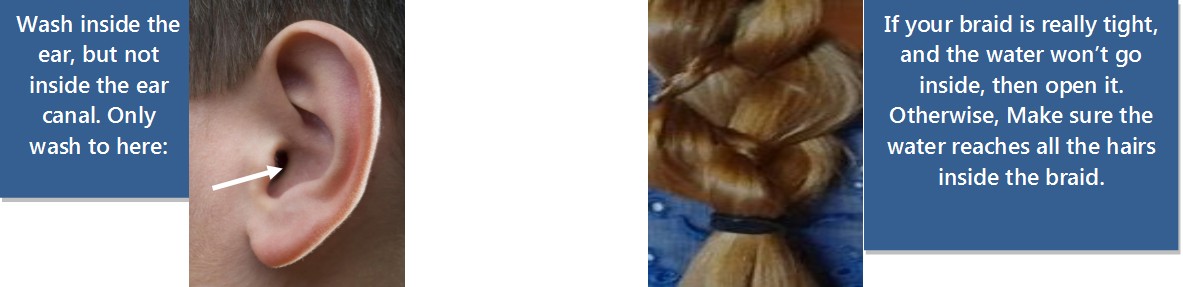
[toggle title=”5. Wash your entire body from head to toe.” state=”close”]Start from the top of your head and move down to the rest of your body. It’s better to wash the right side before the left, and the top part of the body before the bottom. Make sure water reaches your entire outer body. This includes all your skin, all hairs on your body, and even inside the ears (but not inside the ear canals, see the picture of the ear below). So wash in this order:

Full Ghusl Described3[/toggle]

Be sure to wash and not just wipe. Washing means the water flows everywhere. Here are some parts people miss, so make sure you wash these:

Inside and behind ears
Inside the belly button
Between the toes
If you have a braid or a beard, the insides of it so water reaches every hair
Any folds of skin
Full Ghusl Described4

[box type=”warning”]Since the entire body is considered as one organ in ghusl, you can start by washing any part of the body you want, even your feet. But starting with the head is best.[/box]
[divider]
[button color=”blue” size=”medium” link=”http://www.deenteens.com/worksheets/3.1.7 ghusl.pdf” target=”blank”]Worksheet[/button]
3.1.8 What Breaks Wudu

[one_half][box type=”success”]

In this unit:

  • There are 4 things that break or nullify wudu.
  • When you break your wudu you get minor hadath on you.
  • You must remove the minor hadath when you want to pray.

[/box][/one_half]

[one_half_last][box type=”note”]

Keywords

  • Nullify
  • Minor Hadath
  • Unconscious[/box][/one_half_last]

[dropcap]E[/dropcap]xcellent, we’ve learned how to make wudu! We learned what is fard in wudu, and what is sunnah. We learned that we must be very careful to perform the fards of wudu correctly so that our wudu will be valid or correct.

But do you know when it becomes necessary to make wudu? What breaks our wudu? Let’s learn it now, insha’Allah.

Four Things that Break Wudu

There are 4 things that break or nullify our wudu. If any of these four things happen, we must make a fresh wudu for our next prayer. Nothing else breaks our wudu other than these four things.

When you break your wudu, you get minor hadath on you. Remember, we said that we can imagine minor hadath to be green paint. That means minor hadath is on your face, arms, head and feet. When you make wudu, you wash that minor hadath from your face, arms, head and feet. Then you can pray, touch the Qur’an, and do anything else that requires you to be in the state of wudu. So what breaks our wudu? Here it is.

The 4 Nullifiers of Wudu or the 4 Things that Break Wudu

[toggle title=”1. If anything exists from the private parts” state=”open”][two_third]whether it is solid, liquid or gas. This usually happens when someone goes to the toilet.[/two_third]

[one_third_last]White toilet bowl in a bathroom[/one_third_last][/toggle]

[toggle title=”2. If someone becomes unconscious.” state=”close”][two_third]That usually happens when someone falls asleep. Sometimes it happens when someone needs to have surgery and the doctor gives him medicine to put him to sleep. But if you fall asleep while you are sitting up straight on a hard surface, it doesn’t break your wudu (though the teacher won’t like it if you do it in class!)[/two_third]

[one_third_last]Cozy comfortable bedroom[/one_third_last][/toggle]

[toggle title=”3. If a man touches a woman’s skin,
even if it happens accidentally.” state=”close”][two_third]It’s the same if a woman touches a man’s skin.[/two_third]

[one_third_last]Conceptual  spiral made of painted human hands[/one_third_last][/toggle]

[toggle title=”4. If someone touches anyone’s private parts with the skin of the inner surface of the hand.” state=”close”][two_third]This could happen if someone touches his own private parts or someone else’s, like when a mother is cleaning her baby. If there is a barrier between your skin and the private parts, it doesn’t break your wudu.[/two_third]

[one_third_last]feet of a baby[/one_third_last][/toggle]

[box type=”warning”]

  • Vomiting does not break your wudu (even though you feel terrible when it happens to you).
  • Laughing in the middle of prayer might break your prayer, but it doesn’t break your wudu.

[/box]
[divider]
[button color=”blue” size=”medium” link=”http://www.deenteens.com/worksheets/3.1.8 nullifiers of wudu.pdf” target=”blank”]Worksheet[/button]

3.1.9 Causes for Ghusl

[one_half][box type=”success”]

In this unit:

  • Six things make ghusl necessary.
  • Three of these only apply to women.
  • When you do not have ghusl, you have major hadath.

[/box][/one_half]

[one_half_last][box type=”note”]

Keywords

  • Major Hadath
  • Period
  • Post Natal Bleeding
  • Maniyy[/box][/one_half_last]

[dropcap]W[/dropcap]hen you do certain things, it breaks your wudu, as we saw in Lesson 3.1.8 (What Breaks Wudu). Similarly, some things break ghusl. Three of these are the same for men and women. But three of them are only for women.

When someone doesn’t have ghusl, we say he has major hadath on him. Remember that major hadath is like an imaginary black paint that covers the whole body. The way to remove major hadath is to make ghusl as we explained in Lesson 3.1.7 (The Full Ghusl Described).

Causes for Ghusl2
[toggle title=”Causes for Men and Women” state=”close”]
1. When a husband and wife have marital relations.

2. When someone has a wet dream or ejaculates something called maniyy.

a. Maniyy comes from the private parts of men and women. Here is how you know what maniyy is:

i.    It ejaculates in spurts

ii.    It exits with pleasure

iii.    When moist it has the odor of bread dough, and when dry that of egg whites

3. When a person dies. May Allah have mercy on the believers who are alive and who have returned to Allah. By the way, when a person dies, he does not get major hadath. But his body still has to be given ghusl. However, if someone is lucky enough to die as a martyr from wounds of battle when he was fighting for Allah, he must not be washed. In that case, we leave his blessed blood on his body and bury him with the blood of his wounds.[/toggle]
[toggle title=”Causes for Women Only” state=”close”]
1. A woman’s period

2. When a woman gives birth

3. When a woman has post natal bleeding. This is like a period that happens after a woman has a baby[/toggle]

After any of the above 6 events, a Muslim must make ghusl before he can pray and do certain other things.
Shower head
[divider]
[button color=”blue” size=”medium” link=”http://www.deenteens.com/worksheets/3.1.9 causes for ghusl.pdf” target=”blank”]Worksheet[/button]

3.1.11 Tayyamum

[one_half][box type=”success”]

In this unit:


  • If we cannot make wudu, we must make tayyamum in place of wudu.
  • Tayyamum can be made if you have no water or the water will harm you.
  • Tayyamum has 4 arkan.

[/box][/one_half]

[one_half_last][box type=”note”]

Keywords

  • Tayyamum
  • Dust[/box][/one_half_last]

[dropcap]W[/dropcap]e explained that wudu and ghusl can only be made with purifying water. But sometimes, we cannot make wudu or ghusl, either because we do not have water, or because using the water would somehow hurt us. Allah has given us permission to make tayyamum in place of wudu or ghusl when we cannot use water for wudu.

Tayyamum does not purify you like wudu and ghusl, but it does allow you to do the things that you need wudu and ghusl for. For example, you can make tayammum and then pray or touch the Qur’an.

Tayyamum does not clean najasah. It only replaces wudu and ghusl.

To make tayyamum, you use pure and purifying dust. This dust can be found mixed with soil or sand. To be sure that the material you are using is really dust, strike it with your hand and make sure the dust rises up in a cloud. If a dust cloud does not form when you strike the material you have, then it is not dust and can’t be used for tayyamum.

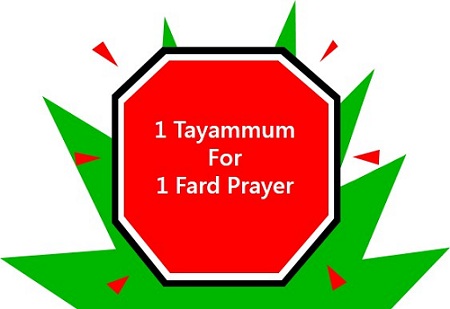
There is something important to know about tayyamum. Only one fard act can be done with one tayyamum. That means one needs a new tayammum for every fard prayer and every
fard tawaf. But on can pray many sunnah prayers with the fard prayer. It’s like wudu gives you an unlimited pass on fard prayers until you break your wudu, but tayammum is a once-only pass for fard prayers.
Tayyamum2

When Can You Make Tayyamum?

[toggle title=”1. If you are travelling or living outside the city and you cannot find water.” state=”close”][one_half][/one_half]
[one_half_last]Jeep in desert[/one_half_last][/toggle]
[toggle title=”2. If you have a wound on an organ that must be washed in wudu (or ghusl)” state=”close”][one_half]but washing that wound will be harmful to you.[/one_half]
[one_half_last]Bandage[/one_half_last][/toggle]

The Steps of Tayyamum

[toggle title=”1. Strike the dust with both hands while saying your niyyah.” state=”close”] [one_half]You must say in your niyyah why you are making tayyamum.[/one_half]

[one_half_last]Tayyamum5[/one_half_last][/toggle]

[toggle title=”2. Wipe your face with your hands.” state=”close”] [one_half]Wipe from your hairline to below your chin and from one ear to the next. Do not miss any part of your face, especially the skin between your mouth and nose![/one_half]

[one_half_last]Tayyamum6[/one_half_last][/toggle]

[toggle title=”3. Strike the dust again.” state=”close”][/toggle]

[toggle title=”4. Wipe your arms” state=”close”] [one_half]first the right arm then the left arm. Wipe the entire arm from the tips of your fingers to your elbow. Make sure you do between your fingers and also your elbow.[/one_half]

[one_half_last][/one_half_last][/toggle]

[toggle title=”5. Do it all in the order” state=”close”]1, then 2, then 3, then 4.[/toggle]

The Fard Acts of Tayyamum (The arkan of tayyamum)

1. Niyyah
2. Striking the dust 2x
3. Wiping the face and arms
4. Doing the steps in order.

How to Make Tayyamum if You Are Wearing a Cast or a Bandage

[two_third]If you have a cast or a bandage on a part of your body that you must wash during wudu, such as your foot, then you will not be able to wash your foot during wudu. Instead of washing your foot, you must make a tayammum that takes the place of washing your foot. Because order is fard in wudu, you will make tayammum when you come to the washing of the foot.[/two_third]
[one_third_last]Cast or bandage[/one_third_last]

Here is what you do:

1. Start making wudu by saying the niyyah while washing the face. Then wash your arms and wipe your head.
2. Wash whichever part of your feet that is uncovered.
3. Wipe water over the cast on your foot.
4. Make tayammum as described above.

[box type=”warning”]You cannot make tayyamum in a city because there will always be water available somewhere. If you can’t find any, make tayyamum and pray; but then pray that prayer again when you find water.[/box]
[divider]
[button color=”blue” size=”medium” link=”http://www.deenteens.com/worksheets/3.1.11 tayammum.pdf” target=”blank”]Worksheet[/button]

3.1.12 Wiping on Khuffs

[one_half][box type=”success”]

In this unit:


  • A khuff is a special footwear that you can wipe on instead of washing your feet in wudu.
  • A khuff must fulfill certain conditions.

[/box][/one_half]

[one_half_last][box type=”note”]

Keywords

  • Khuff/Khuffayn
  • Waterproof
  • Traveler
  • Resident[/box][/one_half_last]

[dropcap]A[/dropcap] khuff is a leather sock or boot that people wear on their feet. A pair of them is called khuffayn. We’ll just call them khuffs to make it easier to remember. Here are some examples of khuffs. The ones that look like socks are special sports socks that fulfill the conditions for khuffs, which we’ll discuss below.

3.1.12 types of khuffs

If you are wearing khuffs, you can wipe on them in wudu instead of washing your feet, but with some rules.

To start with, you have to put on your khuffs after you are completely pure (meaning you made wudu and ghusl if you needed to). You must not take the khuffs off. In fact, you must pray in the khuffs that you wiped on.

Conditions for the Kuff

Not just any socks or boots will do for wiping. Here are some conditions the khuffs have to fulfill in order to be able to wipe on them.

[toggle title=”1. The khuffs must cover the part of
the foot that is washed in wudu” state=”close”]i.e. the entire foot up to and including the ankles.
[three_fourth]Converse[/three_fourth]
[one_fourth_last][/one_fourth_last][/toggle]

[toggle title=”2. The khuffs must be strong enough for you to be able to walk in it on land that’s of medium roughness.” state=”close”]If it’s only good for your comfy house tiles, like thin dress socks, then it’s not good for wiping. And you sure won’t be able to walk on jagged mountains with thin dress socks. Ouch!

[three_fourth][/three_fourth]
[one_fourth_last][/one_fourth_last][/toggle]

[toggle title=”3. It must be strong enough to prevent water from reaching the foot (waterproof).” state=”close”]If the material is durable, then it will be strong enough to prevent water from reaching the foot. It doesn’t matter what your khuff is made from, as long as it’s strong enough material e.g. sealskinz socks or leather socks.
 
This doesn’t mean you have to be able to take a dip in the ocean with your khuff. The important thing is, if you drip water on it, the water won’t reach your foot.[/toggle]

[toggle title=”4. The khuffs and your feet must be pure at the time you are wiping on it.” state=”close”]If there is najasa on your khuffs or feet, remember to purify them first before putting your khuffs on and wiping over them.[/toggle]

How long can I be wiping?

[one_half]Old clock[/one_half]
[one_half_last]1. For 72 hours if you are a traveller on a long trip in which you are allowed to shorten your prayers.

2. For 24 hours if you are not traveling on a trip in which you can shorten your prayers.
We’ll talk about who can shorten prayers in another lesson.[/one_half_last]

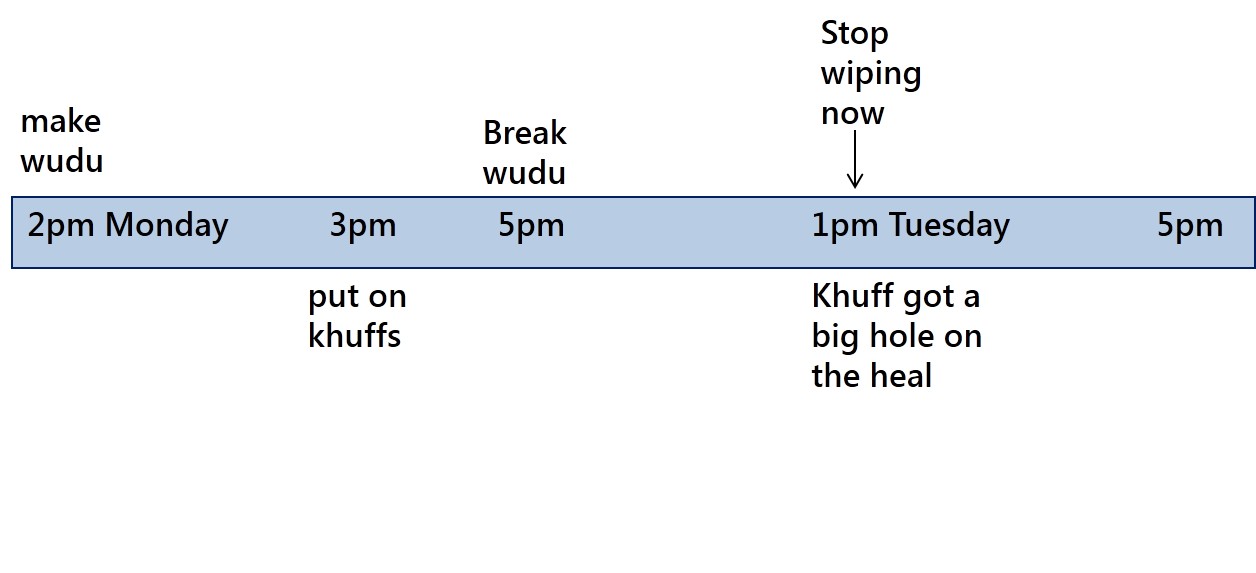
Your time limit starts from the time you lose your wudu, not from the time you put on your khuffs. Think about it this way – the ‘stopwatch’ on your khuff only starts ticking once your wudu is broken. For example, if Iman makes wudu at 10 am, puts her khuff on immediately, then goes to use the bathroom at 12 pm, her khuff is valid for 24 hours from 12 pm.

You can’t wipe anymore if:

1. You take off your khuff or khuffs.
2. The khuff no longer fulfills the conditions for wiping, such as having a hole in it.
3. You end your time limit of 24 or 72 hours.
4. You get major hadath.

Take a look at this:
Wiping on Khuffs4

How to wipe a khuff?

[one_half]Make wudu completely by washing all the organs of wudu.

Put on your khuffs.

Next time you break your wudu and want to make a new wudu, perform the wudu like usual. But then, when you get to your feet, wipe your khuffs instead of washing your feet.[/one_half]

[one_half_last]Wiping on Khuffs5[/one_half_last]

To wipe your khuffs, wet your hand and wipe the top of the khuff. Make sure you wipe the top. If you don’t wipe the top, it doesn’t count, even if you wipe other parts.
[divider]
[button color=”blue” size=”medium” link=”http://www.deenteens.com/worksheets/3.1.12 khuffs.pdf” target=”blank”]Worksheet[/button]

3.2.1 The Salah (Prayer)

[one_half][box type=”success”]

In this unit:

  • The Salah is the most important worship a Muslim performs.
  • Fard acts are the most important acts we do; however, even sunnah acts will make us better Muslims.[/box][/one_half]

[one_half_last][box type=”note”]

Keywords

  • Salah
  • Arkan
  • Rukn[/box][/one_half_last]

[dropcap]T[/dropcap]he first of our acts that will be judged by Allah on the Day of Judgment is our prayer. If the prayer is good, all our other acts will be good. May Allah fill our scales with accepted prayers. Our salah or prayer is the special way we worship Allah.
 
In these lessons, you will not learn the whole process of prayer. You need to learn that from your teacher. It will require a lot of practice; may Allah make it easy from you and accept all your prayers.
 
You will learn the arkan of prayer. Remember that arkan is the plural of rukn (which are the acts that are fard). You will also learn what acts in the prayer are sunnah (highly recommended to do) and what acts are hay’ah (recommended).
The reason we learn about the different types of acts in prayer is so that we know how to fix any mistakes we make in our prayer. You fix a mistake in a fard of prayer in a special way.
 
Some people think that if an act is not fard, it is not important. That is not true at all. All our worships are important. The more you do for Allah, the more He will love you and reward you. And we all need as much love and reward as we can get!
 
[toggle title=”The Definition of Salah” state=”open”]

Salah is specific words and acts that begin with takbir and end with taslim,
with certain conditions.

[/toggle]

[box type=”warning”]Each of the 5 daily prayers acts like a purification for the Muslims. It washes away our sins.[/box]

3.2.2 Times of the Five Prayers

[one_half][box type=”success”]

In this Unit:

  • There are 5 Prayers that are obligatory for Muslims to pray.
  • The times of these prayers are determined based on the position of the sun in the sky and shadows on the ground.

[/box][/one_half]

[one_half_last][box type=”note”]

Keywords

  • Fajr
  • Sunrise
  • Zuhur
  • Zawal
  • Asar
  • Maghrib
  • Sunset
  • Isha

[/box][/one_half_last]

3.2.2 image

[dropcap]M[/dropcap]uslims are obligated to pray 5 times per day. Though most of us rely on calendars and watches to tell us the prayer time, in reality, the prayer times are determined by the position of the sun and the length of shadows.

How to determine the times of the 5 prayers:

[toggle title=” 1. Fajr (Dawn prayer)” state=”close”]
Start time: At true dawn which is when you see a white light stretched across the horizon.

End time: When the sphere of the sun starts to appear over the horizon
[/toggle]

[toggle title=” 2. Zuhur (Noon prayer)” state=”close”]
Start time: Zawal – which is when the sun passes its highest point in the sky. You know this has happened when the shadow of an object, say a meter stick, goes from decreasing to increasing.

End time: When the shadow of an object is equal to the length of the object

Or more accurately:

Length of meter stick: 100 cm
Length of shadow at zawal: 5 cm
Length of shadow at end of zuhur = x

x = 100 cm+ 5 cm = 105 cm

When x is 105 cm, zuhur is finished, asr has started.

[/toggle]

[toggle title=” 3. Asar (Evening prayer)” state=”close”]
Start time: End of zuhur

End time: When the entire sphere of the sun sets.
[/toggle]

[toggle title=”4. Maghrib (Sunset prayer)” state=”close”]
Start time: When the sun sets

End time: When the redness of sunset leaves the sky.
[/toggle]

[toggle title=”5. Isha (Night prayer)” state=”close”]
Start time: When the redness of the sunset leaves the sky.

End time: Dawn
[/toggle]

Now watch this video to see how to determine the beginning and end of zuhur and asr.


[divider]
[button color=”blue” size=”medium” link=”http://www.deenteens.com/worksheets/3.2.2 times of the five prayers (watermark).pdf” target=”blank”]Worksheet[/button]

3.2.3 The Adhan and the Iqamah

[one_half][box type=”success”]

In this unit

  • Muslims call the adhan for the daily prayers to announce the entry of the prayer time.
  • The iqamah announces the start of the prayer.
  • Make dua between the adhan and the iqamah.

[/box][/one_half]
[one_half_last][box type=”note”]

Keywords

  • Adhan
  • Iqamah

[/box][/one_half_last]

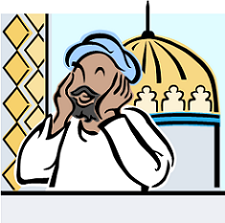
minaret[dropcap]I[/dropcap]t is sunnah to say the adhan to announce the beginning of the 5 daily prayers. It is also sunnah to say the iqamah to let people know that the prayer is just about to begin.
[toggle title=”The Adhan Described” state=”open”]

    1. Make wudu (it is sunnah to do this)
    2. Stand with your chest facing the Qiblah
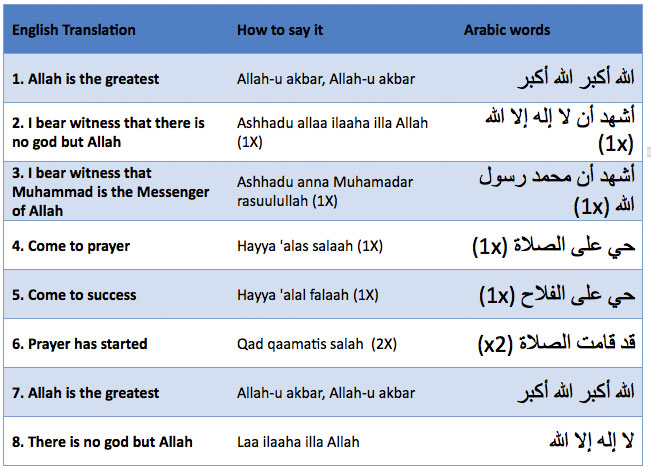
    3. Say the following (only say the Arabic words that are in column 3)

[/toggle]

athaan-meaning
The words of the adhan are in this table

[toggle title=”The Adhan of Fabr/Subh (Morning)” state=”open”]

In the adhan of the morning prayer, it is sunnah to add one more line before line 6; you say:

الصلاة خير من النوم (as-salaatu khayrum min an-nawm) which means prayer is better than sleep.[/toggle]

[divider]

[toggle title=”The Iqamah (Call to Start the Prayer)” state=”open”]

You say the iqamah right before the prayer starts. You can say the iqamah whether praying with a group or by yourself. Women can say the iqamah if they are not praying with men.[/toggle]

The words of the iqamah are very similar to the words of the adhan. Here is what you say:

iqamah-meaning
The words of the iqamah are in this table

[divider]

[toggle title=”Who Can Make the Adhan” state=”open”]

A Muslim male who is 7 years or older can make the public adhan. For women, the adhan is not sunnah. The adhan should be said loud enough for some people to hear it.[/toggle]
[divider]

[toggle title=”What to Say When You Hear the Adhan and Iqamah” state=”open”]

It is sunnah for anyone who hears the adhan and iqamah to repeat the statements except

        1. In response to the haya ‘alas salah and haya ‘alal falaah one should say la hawla wa la quwwata illaa bi-Allah (لا حول ولا قوة إلا بالله) which means nothing can change and no one can do anything except by Allah’s (will).
        2. In response to qad qaamatis salah one should say aqaamaha Allah wa adaamahaa wa ja’alany min salihiy ahliha ( وجعلني من صالحي أهلها أقامه الله وأدامه) which means May Allah keep it everlasting and make me of those who uphold it.
        3. In response to the as-salaatu khayrum min an-nawm one should say sadaqta wa barirt (صدقت وبرِرت)  which means you have told the truth and said something good.

[/toggle]

[divider]

[toggle title=”What to Say after the Adhan” state=”open”]

dua

    1. Say salah and salam on the Prophet and his family
    2. Say this du’a
      اللهم رب هذه الدعوة التامة والصلاة القائمة آت محمداً الوسيلة والفضيلة وابعثه مقاما محموداُ الذي وعدته
      Which means, “O Allah, Lord of this perfect call and of the regular prayer which is going to be established. Give Muhammad (saws) the right of intercession and superiority and bestow upon him the station of Praise and Glory which You promised him; You never ever go against Your Promises.
    3. Then make du’a for yourself, your family, your teachers and the Muslims

[/toggle]

[divider]
[button color=”blue” size=”medium” link=”http://www.deenteens.com/worksheets/3.2.3 The Adhan and Iqamah.pdf” target=”blank”]Worksheet[/button]

3.2.4 Times in which Prayer is Makruh

sunrise[dropcap]W[/dropcap]e say these are the times in which prayer is makruh, but really, it is haram to pray at these time. This type of makruh is known as “makruh tahrimi” (kind of like saying makruh to the point of being haram).

Review: The Meaning of Makruh and Haram

Makruh: A makruh act is one that Allah does not like, so it better not to do it. If you do it, you will not be sinful; if you do not do it, you will get reward. Can you name some makruh acts?

Haram: A haram act is one you must never do. If you do it, you will be sinful; if you do not do it, you will get reward from Allah and Allah will love you. Can you name some haram acts?

Makruh tahrimi is similar to haram in that one can be sinful for doing the act.
[toggle title=”Check the table here to understand more…” state=”close”]
3.2.4 table (1)[/toggle]

[toggle title=”There are five times in which it is makruh tahrimi
to pray without a valid reason.
” state=”close”]
3.2.4 table[/toggle]

3.2.2 sun picture

Valid reasons to pray in the Makruh Prayer Times

We said you cannot pray without a valid reason. That means you can pray some prayers during the haram times for valid reasons. Here is a list of prayer you CAN pray at the haram times:

1. Any prayers you missed at their time
2. Make-up prayers
3. Funeral prayer
4. Prostrations for recitation of the Qur’an and for thankfulness
5. The two rakah for tawaf
6. Eclipse prayers
7. Two rakah for a wudu
8. Prayer for rain
9. Istikharah prayer
[divider]
[button color=”blue” size=”medium” link=”http://www.deenteens.com/worksheets/3.2.4 time in which prayer is haram (watermark).pdf” target=”blank”]Worksheet[/button]

3.2.5 Conditions of Prayer

[one_half][box type=”success”]

In this unit:

  • There are 5 conditions you must fulfill before and throughout the prayer.
  • If any of these 5 things is not taken care of, your prayer will be invalid.

[/box][/one_half]

[one_half_last][box type=”note”]

Keywords

  • Conditions
  • Prerequisites
  • Awra
  • Qibla[/box][/one_half_last]

[dropcap]T[/dropcap]here are 5 conditions we must fulfill before we start our prayer. That means there are 5 things we have to do for prayer before we even start praying. These conditions are not part of the prayer. They are prerequisites we must take care of before and during the prayer. A prerequisite is something we are required to do even before we start to pray. Without these, our prayer isn’t valid – our prayer is disqualified.

[toggle title=”1. We must purify ourselves from hadath and filth” state=”open”][one_half]We lift hadath by making wudu and/or ghusl. We remove filth by washing it away from our body and clothes. If filth comes on you, you just wash off the place of the filth with purifying water. You do not have to make wudu if you have filth on you. Wudu is only for lifting hadath.[/one_half]

[one_half_last]

Conditions of Prayer3.jpg
As you make wudu, the hadath (“green paint”) comes off you

[/one_half_last]
[/toggle]

[toggle title=”2. We must cover our awra with pure clothes” state=”close”][one_half]The awra is the parts of the body that have to be covered. In prayer, the awra for girls is everything but the hands and face. Make sure everything else is covered. The color and shape of the body should not show through your clothes. For boys, the awra is from the belly button to the knees. It is also good to cover the upper body. Make sure your clothes are pure; there should be nothing najis on them.[/one_half]
[one_half_last]Conditions of Prayer4[/one_half_last]
[/toggle]

[toggle title=”3. We must stand on a pure place” state=”close”][one_half]Make sure there is no najasa in the place you are standing to pray. The best thing to do is put a prayer rug on the floor or ground. Always keep your prayer rug clean.[/one_half]
[one_half_last]Conditions of Prayer5[/one_half_last][/toggle]

[toggle title=”4. Before we start praying, we must be sure that the time of prayer is in” state=”close”][one_half]Do not start prayer until you are sure the time is in, otherwise you have to pray again.[/one_half]
[one_half_last]Conditions of Prayer6[/one_half_last][/toggle]

[toggle title=”5. We must be sure to face the qiblah” state=”close”][one_half]The qibla or direction for prayer is the Ka’ba in Makkah. If you cannot figure out the direction of the qiblah by yourself, ask someone who would know.[/one_half]
[one_half_last]Conditions of Prayer7[/one_half_last][/toggle]

There are only two situations in which we do not have to face the Qibla:

3.2.5 pray sitting
[divider]
[button color=”blue” size=”medium” link=”http://www.deenteens.com/worksheets/3.2.5 conditions for prayer.pdf” target=”blank”]Worksheet[/button]