3.1.1 Purification

[one_half][box type=”success”]

In this unit

  • A Muslim purifies his body and his clothes.
  • We purify ourselves from najasah and hadath.
  • Minor hadath is on the face, head, arms and feet.
  • Major hadath is on the entire body.

[/box][/one_half]
[one_half_last][box type=”note”]

Keywords

  • Taharah
  • Najasah
  • Virtual
  • Minor Hadath
  • Major Hadath[/box][/one_half_last]

[dropcap]P[/dropcap]urification (taharah) is the special way a Muslim cleans his body and his clothes. As Muslims, there are two types of purification we are concerned about, especially when we pray.

  1. First, we must purify ourselves from najasah (impurity or filth). Najasah is an impure material. Impure things are unclean things that have to be washed away with water. We will learn about najasah in Unit 3.1.3
  2. Second, we must purify ourselves from hadath. While najasah is a physical substance that we can see, hadath is not something we can see. It is just a virtual unclean thing; that means it is something you cannot see but it affects your worship of Allah.

Hadath is two types.

[toggle title=”Minor Hadath” state=”close”][one_third]Minor hadath covers the parts of the body that have to be washed in wudu. When a person does not have wudu, then he has minor hadath on the face, arms, head and feet. See the figure on the right.[/one_third]
[one_third]3.1.1 green boy[/one_third]
[one_third_last]The green color on this boy shows where minor hadath is on the body.[/one_third_last][/toggle]
[toggle title=”Major Hadath” state=”close”][one_third]It covers the entire body. When a person does not have ghusl, then he has major hadath on his entire body. See the figure on the right.[/one_third]
[one_third]3.1.1 black body[/one_third]
[one_third_last]The black color on this man shows where major hadath is on the body.[/one_third_last][/toggle]


[divider]
[button color=”blue” size=”medium” link=”http://www.deenteens.com/worksheets/3.1.1 Purification.pdf” target=”blank”]Worksheet[/button]

3.1.2 Using water for purification

[one_half][box type=”success”]

In this unit:

  • There are three types of water.
  • Use purifying water for purification.
  • Purifying water is from natural resources.

[/box][/one_half]
[one_half_last][box type=”note”]

Keywords

  • Purifying water
  • Pure water
  • Changed water
  • Used water
  • Makruh water[/box][/one_half_last]

[dropcap]W[/dropcap]hen we purify ourselves from hadath or najasah in normal circumstances, we must use water. Allah has made water readily available in natural resources; we have water from the sky and from bodies of water on the earth. Water has three special characteristics: clear color, special taste and a special smell.
 

Four types of water

[toggle title=”1. Purifying water” state=”close”]The water we use for purification must be purifying. That means it should be water that is free from najasah. Also it means that the water was not used before for another type of purification. Finally, the water should have its original color, taste and smell.[/toggle]
[toggle title=”2. Pure water” state=”close”]
This water is nice and clean; but it cannot be used for purification. Purifying water becomes pure water for 2 reasons:

a) It is used: If it is used for another purification (wudu or ghusl). The water that was used for making wudu is still clean, but it cannot be used to purify other things. Why? Because now it has hadath in it. Remember the boy with the green paint on his face, arms, head, and feet? Just imagine that green paint in your wash water when you make wudu.
3.1.2 - used water
b) It is changed: If something is mixed with the water so that its color, taste or smell is changed. See the diagram below for an example of pure water.[/toggle]
[toggle title=”3. Impure water” state=”close”]This water is not pure because something impure (najis) got into it. Do not make wudu with impure water! It won’t be able to purify you from minor hadath.[/toggle]
[toggle title=”4. Sun-heated water” state=”close”]This is water that has been heated in direct sunlight, in a metal container, in very hot places during the hot season. While the water is still hot, it’s makruh to use this water on your body. But once it cools down, it’s not longer makruh to use, so you can go ahead and use it.[/toggle]
3.1.2 - Types of water
[box type=”warning”]

  • Water from natural resources such as rain, rivers, oceans and streams is all purifying.
  • Water does not become used or changed or najis if the amount is very large. That’s why an entire river or ocean would not become najis.

[/box]
[divider]
[button color=”blue” size=”medium” link=”http://www.deenteens.com/worksheets/3.1.2 water.pdf” target=”blank”]Worksheet[/button]

3.1.3 Cleaning Filth

Some things are considered filth and have to be removed in a particular way.
[divider]
[one_half]
[box type=”success”]

In this unit:

  • There are three types of impurity.
  • There is a lengthy procedure for removing major impurity.
  • Water must be used to remove impurity.[/box]

[/one_half]
[one_half_last][box type=”note”]

Keywords

  • Najis
  • Najasah
  • Valid
  • Edible
  • Slaughtered
  • Mughallazah
  • Mukhaffafah[/box][/one_half_last]

[dropcap]T[/dropcap]here are some things that Islam considers to be impure (najis). Impure is different from dirty. Some things are dirty, but they are pure. An example of a dirty thing is rotten food. Some things seem clean, but they are najis. An example of this is the hairs that fall off a cat.

Najasah (Impurity)2

Impure things (najasah) have to be removed from our bodies and our clothes in a special way before we pray. If they are on us while we pray, our prayer will not be valid. That means it’s like we didn’t pray at all! Also, if these impure items get into water, they make the water impure.

It’s better to remove dirty things from our body so we can stay clean and healthy. Unlike with impure things, there’s no special way to remove dirt. You can remove it in any way you like. Also, if you do pray with something dirty on you, your prayer will still be valid.

There are three types of najasah: major, regular, and light. They are divided into these categories based on how we are supposed to clean them.

Three types of Najasah

[toggle title=”Najasah mughallazah (major impurity)” state=”close”]Najasah (Impurity)3[/toggle]
[toggle title=”Najasah (regular impurity)” state=”close”]3.1.3 - NajasahA short discussion on some of the regular impurities:

For this discussion, “excused” means that your prayer is valid even if you have that najasah on your clothes or body.

1. Blood or pus on our body or clothes is excused if it is our own blood or pus, it is not mixed with other things, and we did not cause the bleeding on purpose.

3. Beware of alcohol in makeup and perfumes. Always check the ingredients!

4. A little bit of najis animal hairs is excused.

5. Animal skin can become pure if it is tanned. But the skin of a dog or pig will never become pure.[/toggle]
[toggle title=”Najasah mukhaffafah (light najasah)” state=”close”]The urine of baby boys is light najasah as long as the baby boy is less than 2 lunar years of age and has only eaten milk.[/toggle]

How to Purify Something That Has Become Najis (impure)

[toggle title=”Major impurity” state=”close”]

First wash off the impurity until its color, taste and smell are gone. Then wash the impure area 7 times with purifying water. In one of those washes, mix the water with dust, then wash the impure area with it.

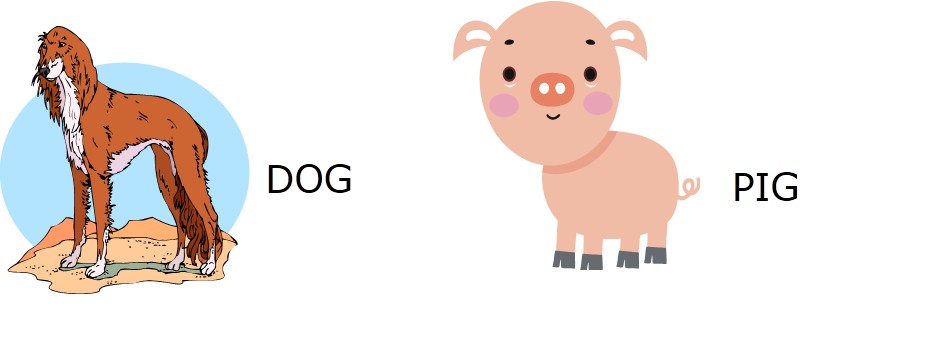
Let’s take an example. Suppose a dog licked your hand. Here is what you would do to clean it:

[/toggle]
[toggle title=”Regular impurity” state=”close”]First wash off the impurity until its color, taste and smell are gone. Then wash the impure area 1, 2 or 3 times with purifying water.

Let’s take another example. Suppose you got some urine on your hand. Here is how you would clean it:
Wash Najasah 2[/toggle]
[toggle title=”Minor impurity” state=”close”]Squeeze or wring out all the baby’s urine. Sprinkle the entire affected area with purifying water until the whole area is covered by water droplets. Now the area is clean. Since cleaning it is easy, a baby boy’s urine is called light najasah.[/toggle]

[box type=”warning”]

  • If you have a tiny bit of blood from dead bugs on you, it is excused.
  • When you tan an animal skin, you use chemicals to dry it up.[/box]

[divider]
[button color=”blue” size=”medium” link=”http://www.deenteens.com/worksheets/3.1.3 najasah.pdf” target=”blank”]Worksheet[/button]

3.1.4 The Full Wudu Described

When we want to pray, we must make wudu. Wudu requires an intention and some washing and some wiping.
[divider]

[one_half][box type=”success”]

In this unit:

  • Wudu removes minor hadath from the face, arms, head and feet.
  • Every body part in wudu can be washed (or wiped) 1, 2 or 3 times.
  • Wudu requires a niyyah.

[/box][/one_half]

[one_half_last][box type=”note”]

Keywords

  • Niyyah
  • Fard
  • Sunnah
  • Hadath[/box][/one_half_last]

[toggle title=”1. Wash your hands while saying the niyyah for the sunnahs of wudu in your heart.” state=”open”]
Wash your hands all the way up to and including your wrist. You can wash your hands 1, 2 or 3 times; but 3 is best. You only need to say the niyyah once. All the parts of wudu can be washed 1, 2 or 3 times; but 3 is best.
The Full Wudu Described1[/toggle]
[toggle title=”2. Rinse your mouth.” state=”close”]
[three_fourth] Take a handful of water and put it in your mouth. Move the water around in your mouth, then spit it out. Don’t swallow![/three_fourth]

[one_fourth_last]The Full Wudu Described2[/one_fourth_last][/toggle]
[toggle title=”3. Rinse your nose.” state=”close”]
[three_fourth] Take a handful of water and gently sniff it into your nose. Don’t do it too hard or it will hurt.[/three_fourth]

[one_fourth_last]The Full Wudu Described3[/one_fourth_last][/toggle]
[toggle title=”4. Wash your face while saying your niyyah in your heart.” state=”close”]
Wash from just above your hairline to below your chin; and from one ear to the other. Make sure you get lots of water on your face. Don’t just wipe water on the sides of your face. The words of the intention are given in the
The Full Wudu Described4[/toggle]
[toggle title=”5. Wash your arms” state=”close”]
[one_half]from your fingertips all the way to your elbow. Wash your elbows too. Make sure you wash with flowing water. Don’t just wipe your arms or it won’t be a proper wudu.[/one_half]

[one_half_last]The Full Wudu Described5[/one_half_last][/toggle]
[toggle title=”6. Wipe a part of your head.” state=”close”]
[one_half]Wet your hand and wipe at least one hair; but it is better to wipe the
whole head. You can wipe your head 1, 2 or 3 times; but 3 is best.[/one_half]

[one_half_last]The Full Wudu Described6[/one_half_last][/toggle]
[toggle title=”7. Wipe the inside and outside of your ear” state=”close”]
The Full Wudu Described7[/toggle]
[toggle title=”8. Wash your feet” state=”close”]
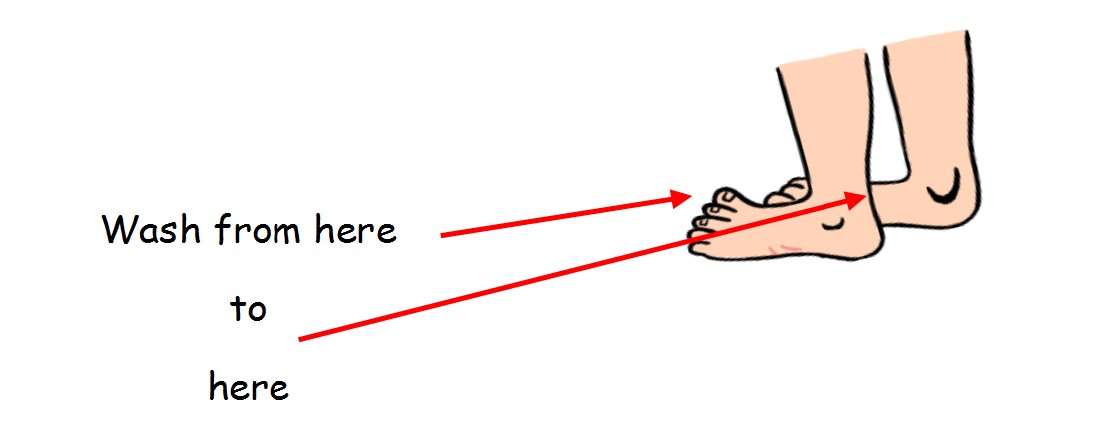
…from the tips of your toes up to and including your ankles.
The Full Wudu Described8[/toggle]
[toggle title=”9. Do it all in that order.” state=”close”]
We will talk about how to fix a mistake if you forget one act or do it out of order.[/toggle]

Fard and Sunnah of Wudu

In the next section, you will learn that 6 of the acts of wudu are fard. All the rest of the acts are sunnah. The acts that are fard must be performed and they must be performed in order. You must never leave one of these acts. If you do forget one of them, or if you do it out of order, you will have to correct your mistake. We will learn how to correct mistakes in a later lesson, insha Allah.
Sunnah and Fard of Wudu

[box type=”warning”]

  • The niyyah (intention) is the words you say in your heart to state what you are doing. Worships are not valid without niyyah.
  • In the niyyah, you must state what you are doing. If the act is fard, you must say so in your niyyah.

[/box]
[divider]
[button color=”blue” size=”medium” link=”http://www.deenteens.com/worksheets/3.1.4 full wudu.pdf” target=”blank”]Worksheet[/button]

3.1.5 The Arkan of Wudu

[one_half]
[box type=”success”]

In this unit:

  • Wudu has 6 fard acts.
  • The fard parts of any ibadah are called its arkan.
  • You must never leave any of the arkan or your wudu will be invalid.

[/box]
[/one_half]

[one_half_last][box type=”note”]

Keywords

  • Rukn
  • Arkan
  • Fard[/box][/one_half_last]

[dropcap]W[/dropcap]e saw in Lesson 3.1.4 that wudu has many acts. However, all of those acts are not fard or wajib. The fard parts of anything we do are called its arkan. The singular of arkan is rukn. So wudu has 6 fard acts which are 6 arkan. We explained in Preliminaries that a fard act is one that must always be done. If you leave one of these acts, your wudu will not be valid. If you leave a fard act, you have to make it up.

In wudu, the 6 fard acts are: niyyah, washing the face, washing the arms, wiping the head, washing the feet and doing it all in that order. The figure below will help you remember them.

The Arkan of Wudu2
[divider]
[button color=”blue” size=”medium” link=”http://www.deenteens.com/worksheets/3.1.5 Arkan of Wudu.pdf” target=”blank”]Worksheet[/button]

3.1.6 What is Wudu Needed For?

[one_half][box type=”success”]

In this unit:

  • We have to be in wudu to do certain acts of worship.
  • Prayer, any type of sajda, and tawaf all require wudu.

[/box][/one_half]

[one_half_last][box type=”note”]

Keywords

  • Sujud Tilawah
  • Sujud Al-Shukr
  • Tawaf[/box][/one_half_last]

[toggle title=”1. To be able to pray or give the Friday khutbah.” state=”open”]
[two_third]You also need wudu to make sujud al-tilawah (sujud for reading certain parts of the Qur’an) and to make sujud al-shukr (sujud for thanking Allah). Sajdah is considered an act of prayer; that is why we always have to have wudu to make any type of sajdah.[/two_third]
[one_third_last]What is Wudu Needed For[/one_third_last][/toggle]

[toggle title=”2. To make tawaf around the Ka’ba.” state=”close”]
[two_third]Tawaf around the Ka’ba means to go around the Ka’ba.[/two_third]
[one_third_last]What is Wudu Needed For2.png[/one_third_last][/toggle]

[toggle title=”3. To touch or carry the Qur’an.” state=”close”]
[two_third]By Qur’an, we mean anything that has lots of the Qur’anic Arabic words on it. So if a piece of paper has lots of Qur’an written on it, you will need wudu in order to touch the paper. By lots of Qur’an we mean that half or more of that paper or book is the Arabic words of the Qur’an. If you do not have wudu, you cannot touch or carry the Qur’an even if it is covered with something.[/two_third]
[one_third_last]What is Wudu Needed For3[/one_third_last][/toggle]

[box type=”warning”]

  • If you do not have wudu, then you cannot pray, you cannot make tawaf around the Ka’ba and you cannot touch the Qur’an.
  • You do not need wudu to recite the Qur’an, you only need wudu to touch the Qur’an.[/box]

[divider]
[button color=”blue” size=”medium” link=”http://www.deenteens.com/worksheets/3.1.6 what wudu is needed for.pdf” target=”blank”]Worksheet[/button]

3.1.7 Full Ghusl Described

[one_half][box type=”success”]

In this unit:

  • Ghusl removes major hadath from the whole body.
  • Every act in ghusl can be performed 1, 2 or 3 times.
  • Ghusl requires an intention.

[/box][/one_half]

[one_half_last][box type=”note”]

Keywords

  • Ghusl
  • Major Hadath
  • Najasah
  • Intention[/box][/one_half_last]

[dropcap]J[/dropcap]ust as wudu removes minor hadath from our body, ghusl removes major hadath from the body. Remember that we said major hadath is like black paint that covers the whole body? Well, when somebody has major hadath, they have to make ghusl to become pure again.

Making ghusl is just like taking a shower, but with some rules.

The Full Ghusl Described

[toggle title=”1. Wash off any najasah that may be on any part of your body.” state=”open”]There is no intention required here because removing najasah does not require an intention.

Dog
http://www.publicdomainpictures.net/view-image.php?image=46834&picture=dog&large=1

[one_half][/one_half]

[one_half_last]For example, wash 7 times with water, once with dust mixed in water, if a dog got you.[/one_half_last][/toggle]

[toggle title=”2. Wash your private parts while making this intention:” state=”close”]

I intend to remove major hadath from my private parts. Or

نَوَيتُ رَفعَ الحَدَثِ الأَكبَرِ مِنْ عَورَتِي

This is a good thing to do because if you have major and minor hadath together, ghusl will wash away both. Just remember that if you wash your private parts after you start ghusl, you’ll get minor hadath again.[/toggle]

[toggle title=”3. Make wudu.” state=”close”]This wudu does not take away minor hadath. It is just a sunnah part of ghusl. Do the wudu in the same way we described in the past, but with just one change.

Faucet
photo credit: deqalb via photopin cc

[one_half][/one_half]

[one_half_last][/one_half_last]

While you are washing your face, say,
I intend to do wudu as a sunnah of ghusl. Or

نَوَيتُ الوُضُوءَ سُنَّةً لِلغُسلِ

shower_pubdom
http://www.publicdomainpictures.net/view-image.php?image=2778&picture=shower-head

[/toggle]
[toggle title=”4. Say the niyyah for ghusl in your heart while pouring water on your head.” state=”close”]
[one_half][/one_half]
[one_half_last]I intend to do fard ghusl. Or

نَوَيتُ فَرضَ الغُسلِ

Remember that niyyah has to be said with the first fard act of any worship. Since washing the entire body is the first fard act of ghusl, you can say your niyyah as soon as you start washing any part of your body. It is recommended to start by washing the head.[/one_half_last][/toggle]

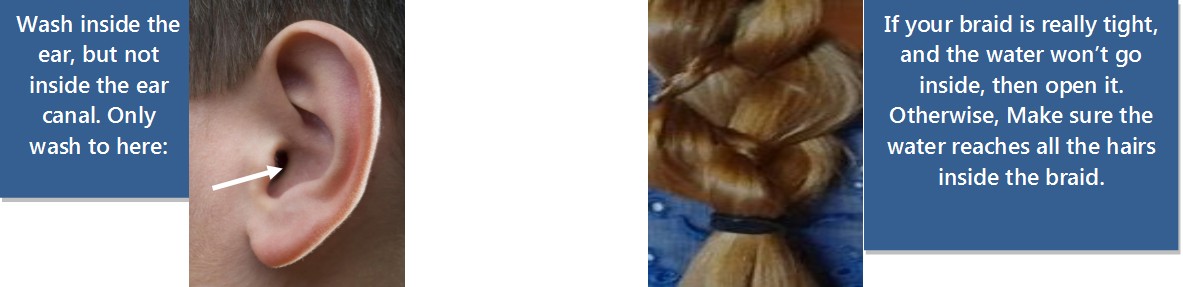
[toggle title=”5. Wash your entire body from head to toe.” state=”close”]Start from the top of your head and move down to the rest of your body. It’s better to wash the right side before the left, and the top part of the body before the bottom. Make sure water reaches your entire outer body. This includes all your skin, all hairs on your body, and even inside the ears (but not inside the ear canals, see the picture of the ear below). So wash in this order:

Full Ghusl Described3[/toggle]

Be sure to wash and not just wipe. Washing means the water flows everywhere. Here are some parts people miss, so make sure you wash these:

Inside and behind ears
Inside the belly button
Between the toes
If you have a braid or a beard, the insides of it so water reaches every hair
Any folds of skin

Full Ghusl Described4

[box type=”warning”]Since the entire body is considered as one organ in ghusl, you can start by washing any part of the body you want, even your feet. But starting with the head is best.[/box]
[divider]
[button color=”blue” size=”medium” link=”http://www.deenteens.com/worksheets/3.1.7 ghusl.pdf” target=”blank”]Worksheet[/button]

3.1.8 What Breaks Wudu

[one_half][box type=”success”]

In this unit:

  • There are 4 things that break or nullify wudu.
  • When you break your wudu you get minor hadath on you.
  • You must remove the minor hadath when you want to pray.

[/box][/one_half]

[one_half_last][box type=”note”]

Keywords

  • Nullify
  • Minor Hadath
  • Unconscious[/box][/one_half_last]

[dropcap]E[/dropcap]xcellent, we’ve learned how to make wudu! We learned what is fard in wudu, and what is sunnah. We learned that we must be very careful to perform the fards of wudu correctly so that our wudu will be valid or correct.

But do you know when it becomes necessary to make wudu? What breaks our wudu? Let’s learn it now, insha’Allah.

Four Things that Break Wudu

There are 4 things that break or nullify our wudu. If any of these four things happen, we must make a fresh wudu for our next prayer. Nothing else breaks our wudu other than these four things.

When you break your wudu, you get minor hadath on you. Remember, we said that we can imagine minor hadath to be green paint. That means minor hadath is on your face, arms, head and feet. When you make wudu, you wash that minor hadath from your face, arms, head and feet. Then you can pray, touch the Qur’an, and do anything else that requires you to be in the state of wudu. So what breaks our wudu? Here it is.

The 4 Nullifiers of Wudu or the 4 Things that Break Wudu

[toggle title=”1. If anything exists from the private parts” state=”open”][two_third]whether it is solid, liquid or gas. This usually happens when someone goes to the toilet.[/two_third]

[one_third_last]White toilet bowl in a bathroom[/one_third_last][/toggle]

[toggle title=”2. If someone becomes unconscious.” state=”close”][two_third]That usually happens when someone falls asleep. Sometimes it happens when someone needs to have surgery and the doctor gives him medicine to put him to sleep. But if you fall asleep while you are sitting up straight on a hard surface, it doesn’t break your wudu (though the teacher won’t like it if you do it in class!)[/two_third]

[one_third_last]Cozy comfortable bedroom[/one_third_last][/toggle]

[toggle title=”3. If a man touches a woman’s skin,
even if it happens accidentally.” state=”close”][two_third]It’s the same if a woman touches a man’s skin.[/two_third]

[one_third_last]Conceptual  spiral made of painted human hands[/one_third_last][/toggle]

[toggle title=”4. If someone touches anyone’s private parts with the skin of the inner surface of the hand.” state=”close”][two_third]This could happen if someone touches his own private parts or someone else’s, like when a mother is cleaning her baby. If there is a barrier between your skin and the private parts, it doesn’t break your wudu.[/two_third]

[one_third_last]feet of a baby[/one_third_last][/toggle]

[box type=”warning”]

  • Vomiting does not break your wudu (even though you feel terrible when it happens to you).
  • Laughing in the middle of prayer might break your prayer, but it doesn’t break your wudu.

[/box]
[divider]
[button color=”blue” size=”medium” link=”http://www.deenteens.com/worksheets/3.1.8 nullifiers of wudu.pdf” target=”blank”]Worksheet[/button]

3.1.11 Tayyamum

[one_half][box type=”success”]

In this unit:


  • If we cannot make wudu, we must make tayyamum in place of wudu.
  • Tayyamum can be made if you have no water or the water will harm you.
  • Tayyamum has 4 arkan.

[/box][/one_half]

[one_half_last][box type=”note”]

Keywords

  • Tayyamum
  • Dust[/box][/one_half_last]

[dropcap]W[/dropcap]e explained that wudu and ghusl can only be made with purifying water. But sometimes, we cannot make wudu or ghusl, either because we do not have water, or because using the water would somehow hurt us. Allah has given us permission to make tayyamum in place of wudu or ghusl when we cannot use water for wudu.

Tayyamum does not purify you like wudu and ghusl, but it does allow you to do the things that you need wudu and ghusl for. For example, you can make tayammum and then pray or touch the Qur’an.

Tayyamum does not clean najasah. It only replaces wudu and ghusl.

To make tayyamum, you use pure and purifying dust. This dust can be found mixed with soil or sand. To be sure that the material you are using is really dust, strike it with your hand and make sure the dust rises up in a cloud. If a dust cloud does not form when you strike the material you have, then it is not dust and can’t be used for tayyamum.

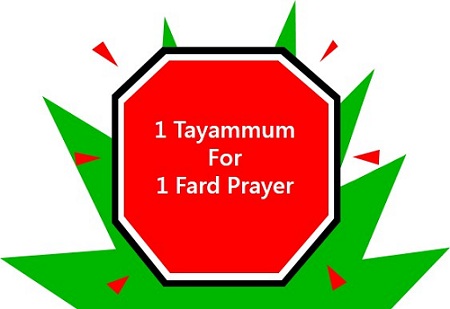
There is something important to know about tayyamum. Only one fard act can be done with one tayyamum. That means one needs a new tayammum for every fard prayer and every
fard tawaf. But on can pray many sunnah prayers with the fard prayer. It’s like wudu gives you an unlimited pass on fard prayers until you break your wudu, but tayammum is a once-only pass for fard prayers.
Tayyamum2

When Can You Make Tayyamum?

[toggle title=”1. If you are travelling or living outside the city and you cannot find water.” state=”close”][one_half][/one_half]
[one_half_last]Jeep in desert[/one_half_last][/toggle]
[toggle title=”2. If you have a wound on an organ that must be washed in wudu (or ghusl)” state=”close”][one_half]but washing that wound will be harmful to you.[/one_half]
[one_half_last]Bandage[/one_half_last][/toggle]

The Steps of Tayyamum

[toggle title=”1. Strike the dust with both hands while saying your niyyah.” state=”close”] [one_half]You must say in your niyyah why you are making tayyamum.[/one_half]

[one_half_last]Tayyamum5[/one_half_last][/toggle]

[toggle title=”2. Wipe your face with your hands.” state=”close”] [one_half]Wipe from your hairline to below your chin and from one ear to the next. Do not miss any part of your face, especially the skin between your mouth and nose![/one_half]

[one_half_last]Tayyamum6[/one_half_last][/toggle]

[toggle title=”3. Strike the dust again.” state=”close”][/toggle]

[toggle title=”4. Wipe your arms” state=”close”] [one_half]first the right arm then the left arm. Wipe the entire arm from the tips of your fingers to your elbow. Make sure you do between your fingers and also your elbow.[/one_half]

[one_half_last][/one_half_last][/toggle]

[toggle title=”5. Do it all in the order” state=”close”]1, then 2, then 3, then 4.[/toggle]

The Fard Acts of Tayyamum (The arkan of tayyamum)

1. Niyyah
2. Striking the dust 2x
3. Wiping the face and arms
4. Doing the steps in order.

How to Make Tayyamum if You Are Wearing a Cast or a Bandage

[two_third]If you have a cast or a bandage on a part of your body that you must wash during wudu, such as your foot, then you will not be able to wash your foot during wudu. Instead of washing your foot, you must make a tayammum that takes the place of washing your foot. Because order is fard in wudu, you will make tayammum when you come to the washing of the foot.[/two_third]
[one_third_last]Cast or bandage[/one_third_last]

Here is what you do:

1. Start making wudu by saying the niyyah while washing the face. Then wash your arms and wipe your head.
2. Wash whichever part of your feet that is uncovered.
3. Wipe water over the cast on your foot.
4. Make tayammum as described above.

[box type=”warning”]You cannot make tayyamum in a city because there will always be water available somewhere. If you can’t find any, make tayyamum and pray; but then pray that prayer again when you find water.[/box]
[divider]
[button color=”blue” size=”medium” link=”http://www.deenteens.com/worksheets/3.1.11 tayammum.pdf” target=”blank”]Worksheet[/button]

3.1.12 Wiping on Khuffs

[one_half][box type=”success”]

In this unit:


  • A khuff is a special footwear that you can wipe on instead of washing your feet in wudu.
  • A khuff must fulfill certain conditions.

[/box][/one_half]

[one_half_last][box type=”note”]

Keywords

  • Khuff/Khuffayn
  • Waterproof
  • Traveler
  • Resident[/box][/one_half_last]

[dropcap]A[/dropcap] khuff is a leather sock or boot that people wear on their feet. A pair of them is called khuffayn. We’ll just call them khuffs to make it easier to remember. Here are some examples of khuffs. The ones that look like socks are special sports socks that fulfill the conditions for khuffs, which we’ll discuss below.

3.1.12 types of khuffs

If you are wearing khuffs, you can wipe on them in wudu instead of washing your feet, but with some rules.

To start with, you have to put on your khuffs after you are completely pure (meaning you made wudu and ghusl if you needed to). You must not take the khuffs off. In fact, you must pray in the khuffs that you wiped on.

Conditions for the Kuff

Not just any socks or boots will do for wiping. Here are some conditions the khuffs have to fulfill in order to be able to wipe on them.

[toggle title=”1. The khuffs must cover the part of
the foot that is washed in wudu” state=”close”]i.e. the entire foot up to and including the ankles.
[three_fourth]Converse[/three_fourth]
[one_fourth_last][/one_fourth_last][/toggle]

[toggle title=”2. The khuffs must be strong enough for you to be able to walk in it on land that’s of medium roughness.” state=”close”]If it’s only good for your comfy house tiles, like thin dress socks, then it’s not good for wiping. And you sure won’t be able to walk on jagged mountains with thin dress socks. Ouch!

[three_fourth][/three_fourth]
[one_fourth_last][/one_fourth_last][/toggle]

[toggle title=”3. It must be strong enough to prevent water from reaching the foot (waterproof).” state=”close”]If the material is durable, then it will be strong enough to prevent water from reaching the foot. It doesn’t matter what your khuff is made from, as long as it’s strong enough material e.g. sealskinz socks or leather socks.
 
This doesn’t mean you have to be able to take a dip in the ocean with your khuff. The important thing is, if you drip water on it, the water won’t reach your foot.[/toggle]

[toggle title=”4. The khuffs and your feet must be pure at the time you are wiping on it.” state=”close”]If there is najasa on your khuffs or feet, remember to purify them first before putting your khuffs on and wiping over them.[/toggle]

How long can I be wiping?

[one_half]Old clock[/one_half]
[one_half_last]1. For 72 hours if you are a traveller on a long trip in which you are allowed to shorten your prayers.

2. For 24 hours if you are not traveling on a trip in which you can shorten your prayers.
We’ll talk about who can shorten prayers in another lesson.[/one_half_last]

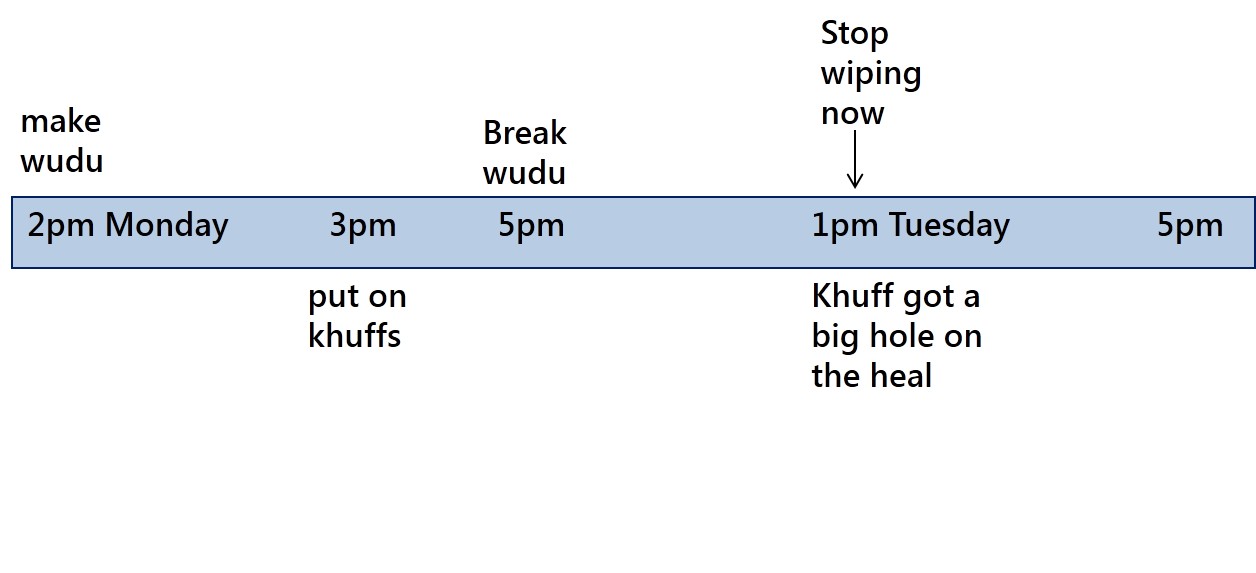
Your time limit starts from the time you lose your wudu, not from the time you put on your khuffs. Think about it this way – the ‘stopwatch’ on your khuff only starts ticking once your wudu is broken. For example, if Iman makes wudu at 10 am, puts her khuff on immediately, then goes to use the bathroom at 12 pm, her khuff is valid for 24 hours from 12 pm.

You can’t wipe anymore if:

1. You take off your khuff or khuffs.
2. The khuff no longer fulfills the conditions for wiping, such as having a hole in it.
3. You end your time limit of 24 or 72 hours.
4. You get major hadath.

Take a look at this:
Wiping on Khuffs4

How to wipe a khuff?

[one_half]Make wudu completely by washing all the organs of wudu.

Put on your khuffs.

Next time you break your wudu and want to make a new wudu, perform the wudu like usual. But then, when you get to your feet, wipe your khuffs instead of washing your feet.[/one_half]

[one_half_last]Wiping on Khuffs5[/one_half_last]

To wipe your khuffs, wet your hand and wipe the top of the khuff. Make sure you wipe the top. If you don’t wipe the top, it doesn’t count, even if you wipe other parts.
[divider]
[button color=”blue” size=”medium” link=”http://www.deenteens.com/worksheets/3.1.12 khuffs.pdf” target=”blank”]Worksheet[/button]